

Introduction
There is a moment that every seasoned traveler knows well. You have checked into a hundred hotels, slept in a thousand beds, and somewhere along the way, the standard amenities begin to blur together into a single forgettable experience. The beige walls, the predictable breakfast spread, the view of the parking lot. That moment, more than anything else, is what makes the world’s most unique hotels so profoundly compelling. These are not simply places to rest between sightseeing. They are the destination itself.
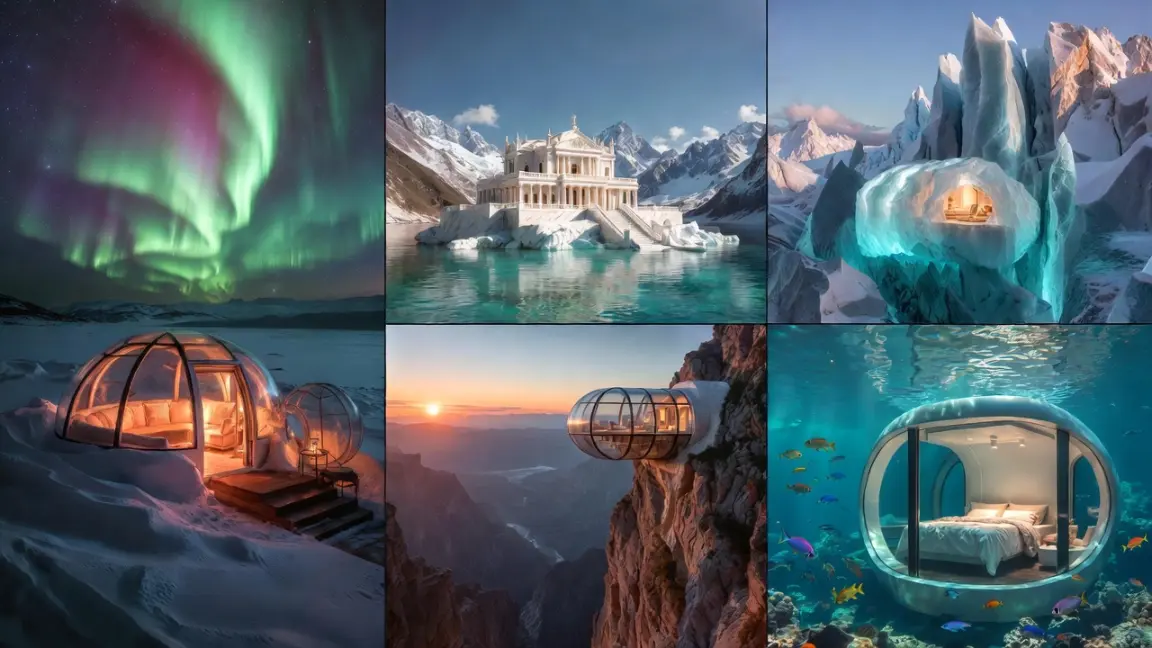
Across every continent, a remarkable collection of properties has reimagined what it means to stay somewhere. From rooms carved into Arctic glaciers to glass pods suspended above ancient canyons, from floating suites on the Indian Ocean to colonial manors where wild giraffes peer through the breakfast window, these unique hotels do not just offer accommodation. They offer transformation.
This guide explores 10 of the most extraordinary hotels on earth, chosen not simply for visual spectacle but for the depth of experience they provide. Whether you are planning a once-in-a-lifetime trip or simply expanding your sense of what travel can be, these properties will challenge your imagination and, perhaps, inspire your next journey.
Why Unique Hotels Have Become the New Standard of Travel

For much of the twentieth century, luxury travel was defined by thread count, marble bathrooms, and the prestige of a brand name on the letterhead. That definition has changed. Today’s most discerning travelers rank experience above elegance and authenticity above opulence. They want to sleep somewhere that could not exist anywhere else in the world, in a room designed around its landscape rather than imposed upon it.
This shift has driven an extraordinary wave of innovation in the hospitality industry. Architects, artists, conservationists, and adventurers have collaborated to create properties that celebrate their environments rather than simply occupy them. The result is a category of travel that feels less like tourism and more like living inside a work of art, a scientific wonder, or a wilderness that has decided to accommodate you.
1. Icehotel, Jukkasjarvi, Sweden
Where Art and Architecture Are Built to Disappear
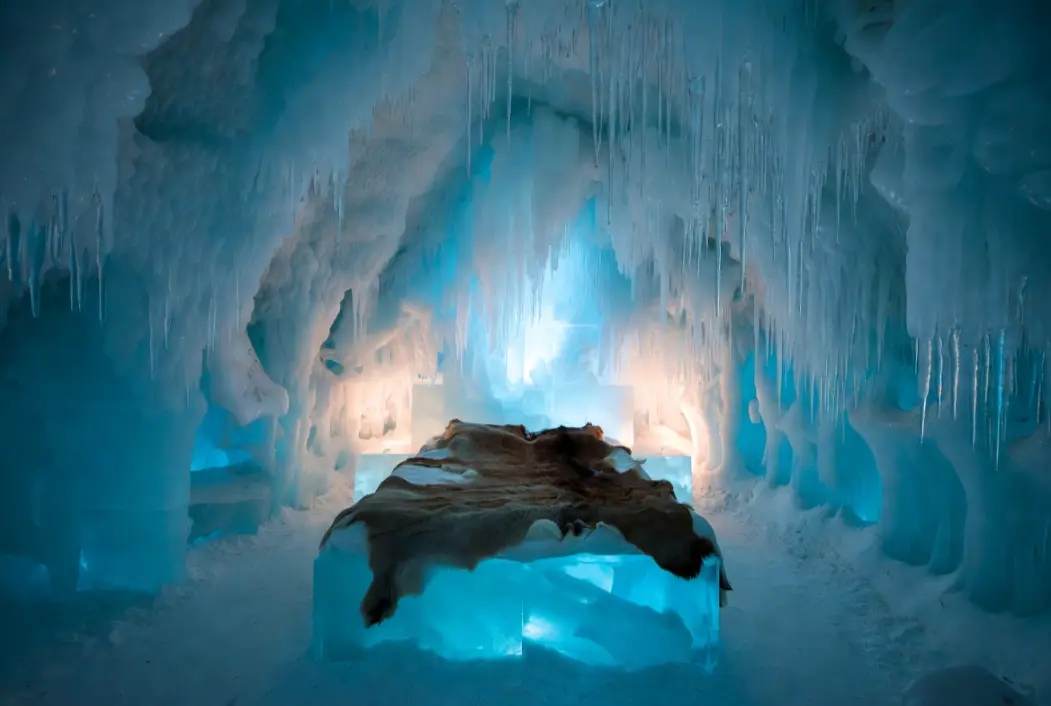
Every winter since 1989, the same remarkable act of creation takes place in the small Swedish village of Jukkasjärvi. Teams of international artists arrive with chainsaws, chisels, and a shared vision. Using ice harvested from the nearby Torne River and tonnes of compacted snow, they carve an entirely new hotel from scratch. By spring, the entire building has melted back into the river from which it came. The following winter, it rises again, completely different.
The art suites are what set Ice hotel apart from its many imitators. Each one is a commissioned sculpture you can sleep inside. Guests have rested in rooms shaped like frozen coral reefs, ice cathedrals, and abstract winter landscapes. Every surface is ice. The bed frame is ice. You sleep in a thermal sleeping bag on a mattress of reindeer hide, and in the morning the staff brings warm lingonberry juice to ease the transition back into the world of solid floors.
For those who want the experience without committing to the cold, the Ice hotel 365 now allows year-round visits through refrigeration. But it is the original seasonal version, with its built-in mortality and its reminder that nothing extraordinary lasts forever, that continues to capture the imagination of travelers worldwide.
2. Kakslauttanen Arctic Resort, Saariselka, Finland
Sleeping Under the Northern Lights in a Glass Igloo
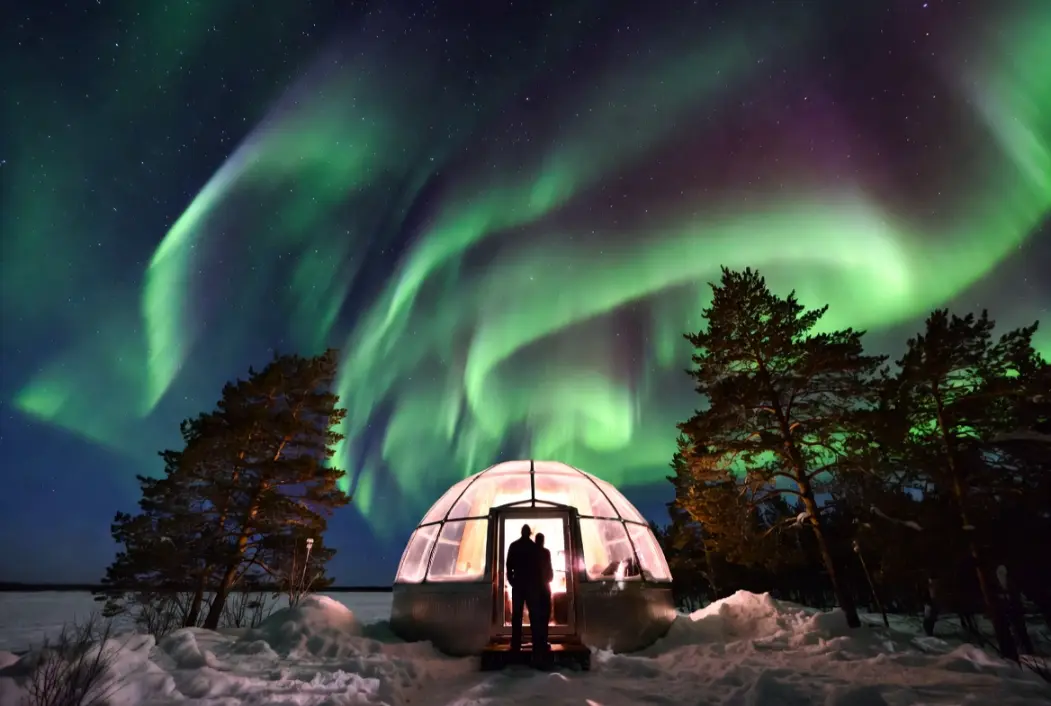
Located near Finland’s largest national park roughly 250 kilometers above the Arctic Circle, Kakslauttanen has earned its place as one of the most photographed properties on earth. The famous glass igloos are thermal glass domes set against a field of snow, each one offering an unobstructed panoramic view of the sky above.
From late August through April, guests staying in these igloos have a genuine chance of witnessing the aurora borealis from the comfort of a warm bed. The specially designed thermal glass prevents fogging, and the insulation keeps the interior pleasant even when it drops to minus thirty degrees outside. You feel warm and sheltered, yet completely exposed to the Arctic sky.
The resort also offers log cabins, traditional smoke saunas, reindeer safaris, husky rides, and ice fishing, making it as much a wilderness destination as an accommodation. Still, it is the glass igloo, and the silent spectacle of the aurora dancing overhead, that defines the experience entirely.
3. Giraffe Manor, Nairobi, Kenya
Breakfast Companions Unlike Any Other
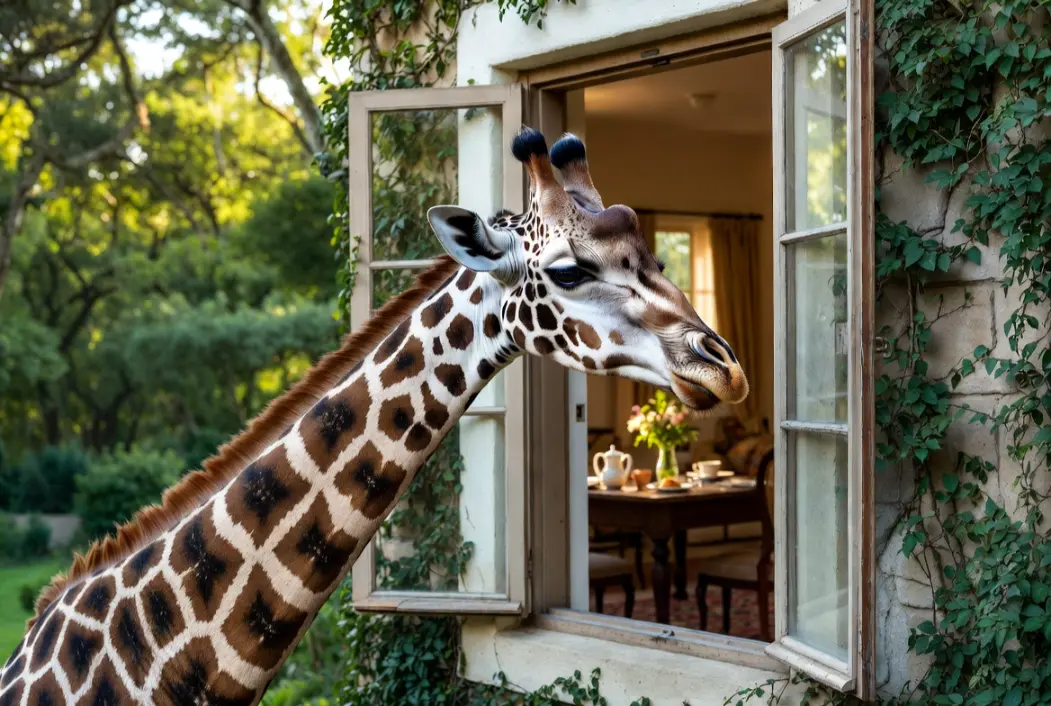
Built in 1932 and set within 140 acres of private forest in Nairobi, Giraffe Manor is a boutique property with just twelve rooms, each furnished in the style of a classic African colonial manor with four-poster beds, antique mirrors, and fireplaces. What makes it irreplaceable is the herd of endangered Rothschild giraffes that roam freely on the grounds.
These giraffes, entirely accustomed to human guests, have developed a habit of inserting their long necks through the open windows at mealtimes. Breakfast at Giraffe Manor is therefore a negotiation. You may find a spotted face resting on your table, a long dark tongue reaching toward your toast, and a pair of patient eyes watching to see if you are feeling generous.
Every room is stocked with giraffe pellets so that guests can feed the animals directly from their bedroom windows. The property works closely with the African Fund for Endangered Wildlife, meaning that staying here is not merely a novelty but a small act of participation in the preservation of one of Africa’s most iconic animals.
4. Sky Lodge Adventure Suites, Sacred Valley, Peru
Sleeping in a Glass Pod on the Face of a Cliff
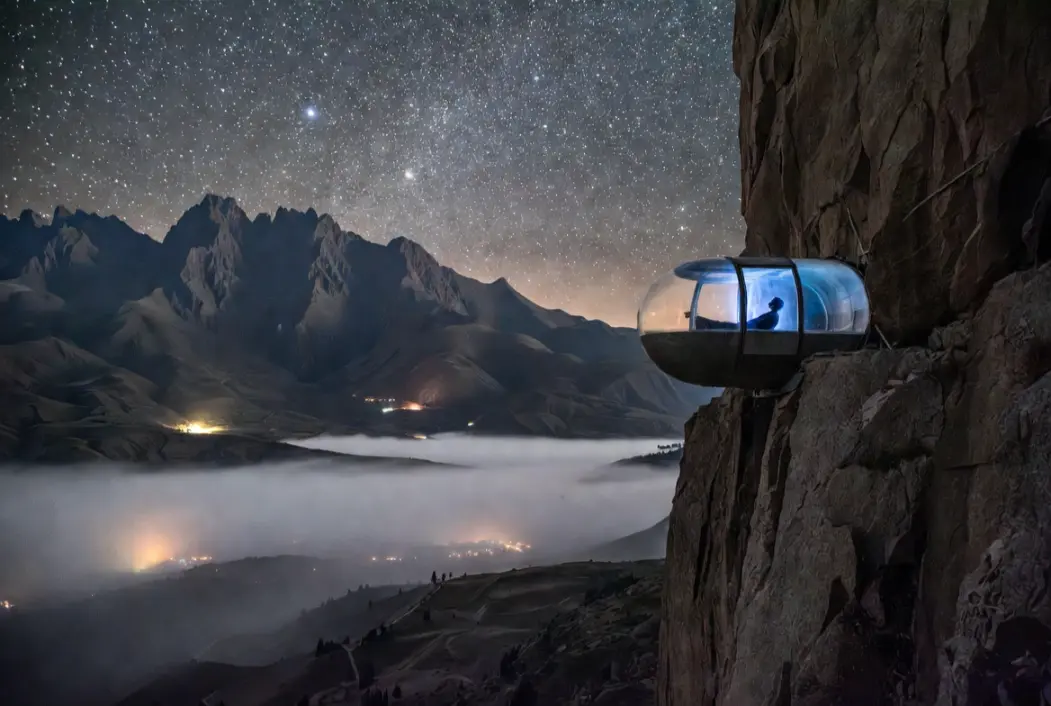
Getting to the Sky Lodge Adventure Suites is half the experience. There are no roads, no lifts, no gentle paths. The only way to reach the three transparent hanging pods overlooking Peru’s Sacred Valley is to strap into a harness and climb a via ferrata route up the side of a 1,000-foot granite cliff. The climb takes between two and three hours, and by the time you arrive, you have fully earned the view.
The pods are constructed from aircraft-grade aluminum and weather-resistant polycarbonate. Each one sleeps two people in genuine comfort, with proper beds and a private bathroom. The walls and ceiling are entirely transparent, offering a 270-degree view of the valley below, the Andean peaks above, and on clear nights, a sky so saturated with stars that the Milky Way appears as a solid band of light.
Guests descend in the morning by zipline. The entire experience is a reminder that some of the most extraordinary places in the world cannot be reached without effort, and that the effort itself is part of what makes the destination meaningful.
5. The Manta Resort, Pemba Island, Tanzania
An Underwater Bedroom in the Indian Ocean
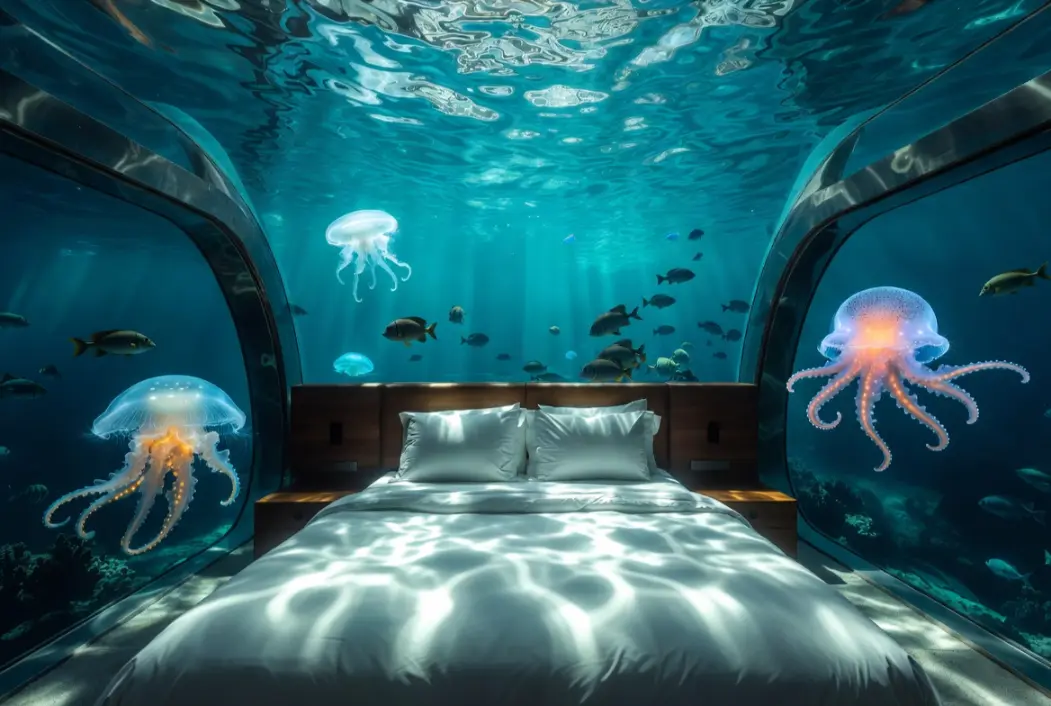
Pemba Island sits off the northern coast of Tanzania, largely unknown to the mainstream tourist trail. The Manta Resort’s most celebrated feature floats several hundred meters offshore, anchored above a natural blue hole on the ocean floor. The underwater room is one of the most singular sleeping environments ever created.
Guests reach the floating structure by boat and descend a spiral staircase to a room situated one and a half meters below the surface. The walls are made of thick glass, and at night, when underwater lights are switched on, the surrounding ocean comes alive. Octopuses, squid, needlefish, and a rotating cast of reef creatures gather outside the glass, drawn by the light, apparently indifferent to the humans watching them from their bed.
There is no Wi-Fi on the floating room. There is nowhere to be but here, suspended between the sky and the sea, watching the ocean conduct its business on the other side of the glass.
6. Juvet Landscape Hotel, Valldal, Norway
Architecture Designed to Disappear Into the Wilderness
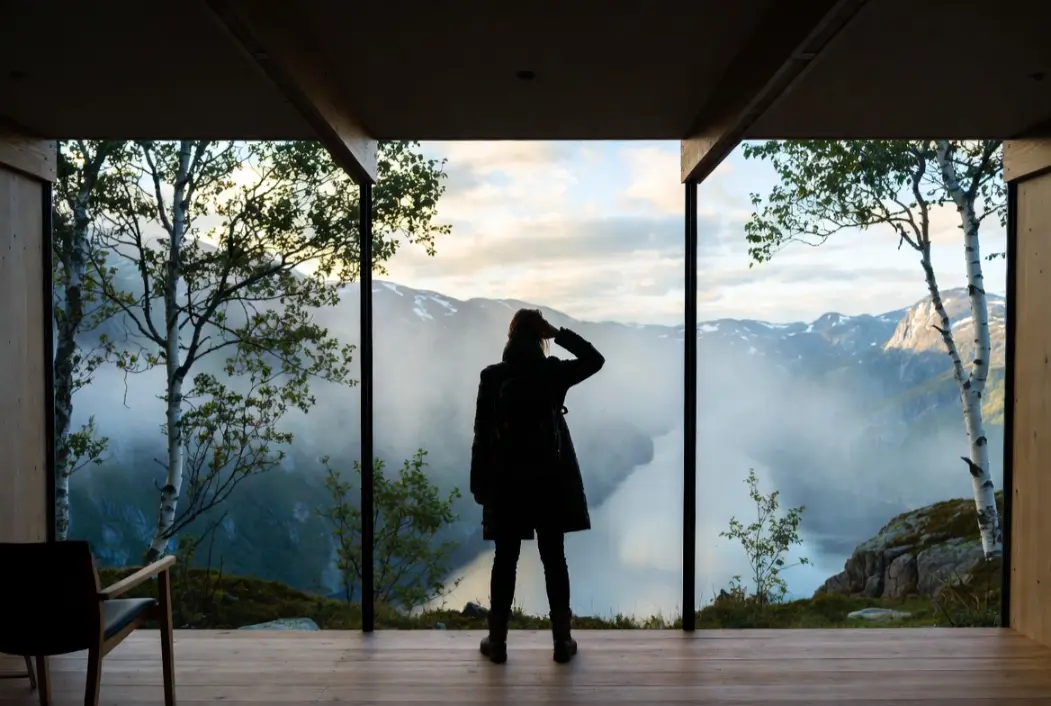
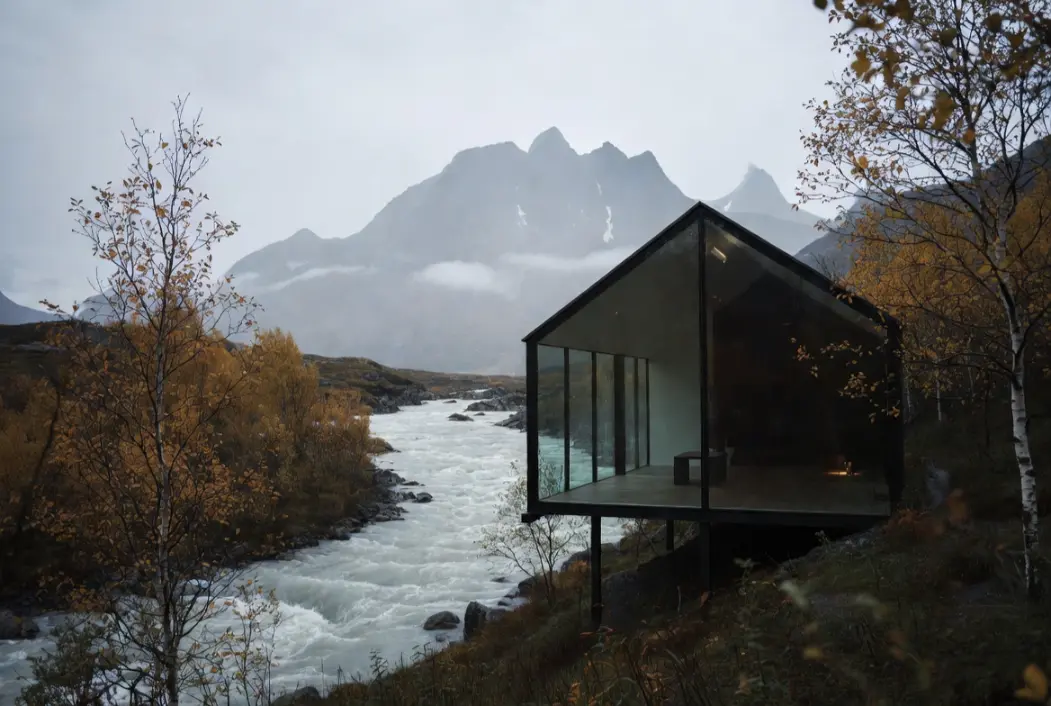
Located in the Valldal valley of western Norway, the Juvet Landscape Hotel was designed with a single architectural philosophy: interfere as little as possible. The individual cabins are positioned among the birch trees along the banks of the Valldala River, each one oriented to face a specific view. The floors are supported on steel posts sunk into the ground, and the trees grow directly beneath the floorboards, undisturbed.
Inside each cabin, the walls are almost entirely glass. The interior is deliberately minimal and dark, with the express purpose of drawing all attention to what lies outside. You are not in a hotel that happens to have a nice view. You are in a viewing platform that has been extended, with considerable thoughtfulness, to include a bed and a bathroom.
The Juvet gained considerable international attention after serving as the filming location for Alex Garland’s film Ex Machina. There is something genuinely otherworldly about it, a sense that civilization has been reduced to its barest essentials and set down in the middle of something far older and larger than itself.
7. Taj Lake Palace, Udaipur, India
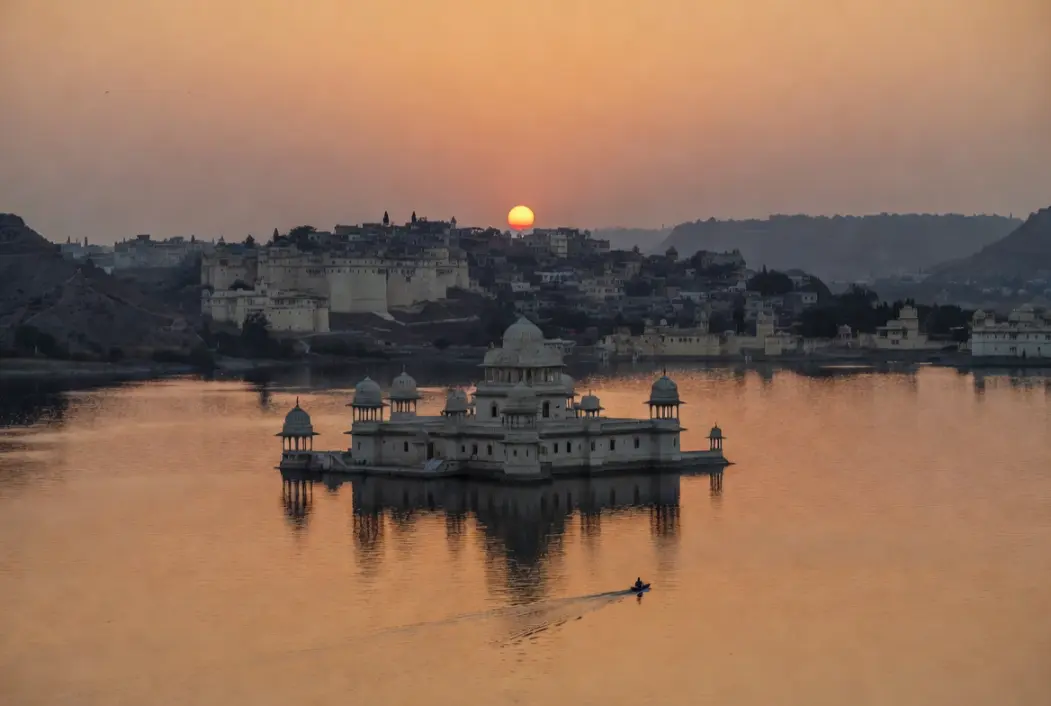
A Marble Palace Floating on the Waters of Lake Pichola
Originally constructed in 1746 as the summer palace of the Maharana of Mewar, the Taj Lake Palace occupies a four-acre island in the middle of Lake Pichola. Built entirely from white marble and black slate, its reflection in the lake has been described by generations of visitors as one of the most beautiful sights in Asia. Today it operates as a luxury hotel, and remains one of the world’s most recognizable architectural landmarks.
Access is by boat only, and the approach across the water at sunset, with the palace glowing in shades of amber and rose, is an arrival that guests consistently describe as one of the great moments of their traveling lives. Carved marble columns, hand-painted walls, and interior courtyards planted with jasmine and marigold create an atmosphere that feels genuinely historic rather than merely decorative.
The hotel was famously featured in the James Bond film Octopussy, but it needs no cinematic endorsement. The particular magic of sleeping in a palace that floats, sovereign and serene, on the waters of a Rajasthani lake is something that no film can fully convey.
8. Sun City Camp, Wadi Rum, Jordan
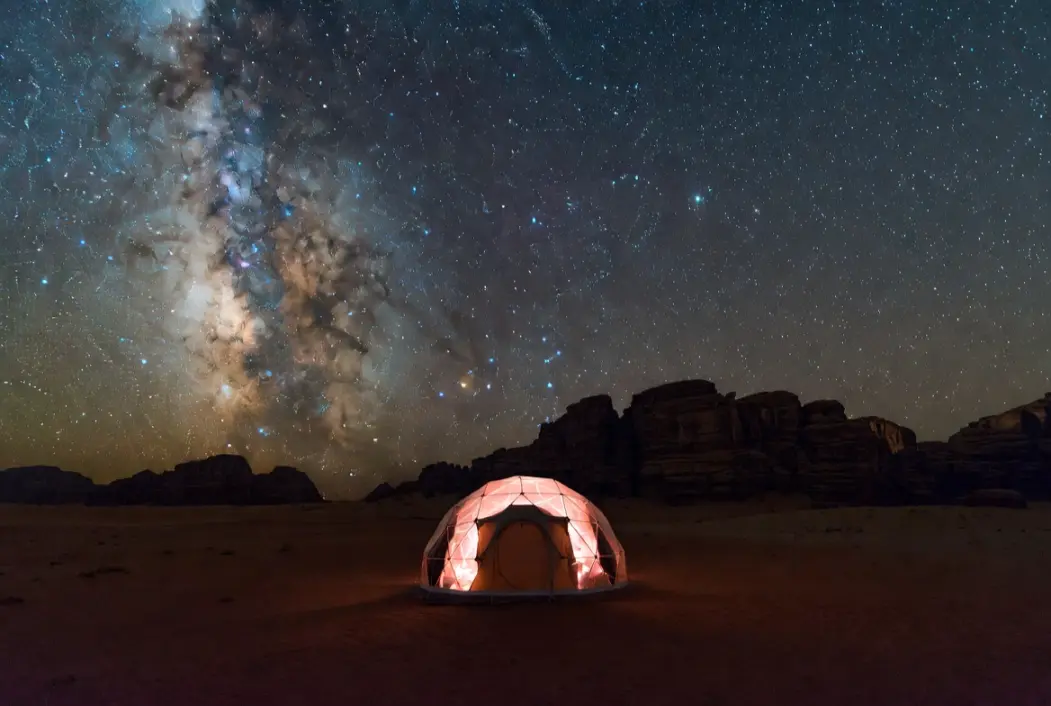
Spending the Night on the Surface of Mars
Wadi Rum is a valley carved into the sandstone and granite of southern Jordan, and it looks, with extraordinary conviction, like another planet. The rust-red desert floor, the towering rock formations, and the quality of light at dawn and dusk have made it a favorite filming location for science fiction productions including The Martian and parts of the Star Wars franchise.
Sun City Camp’s most distinctive accommodation is its collection of transparent dome tents, sometimes called Martian domes, which sit directly on the desert floor. From inside, there is an uninterrupted view of the desert in every direction. At night, the sky over Wadi Rum is one of the darkest in the Middle East, and the dome acts as a private observatory, filling with starlight while the desert outside cools to silence.
Beyond the domes, the camp offers traditional Bedouin activities including camel treks, jeep tours, and the remarkable experience of watching the desert change color through sunrise and sunset. Meals are prepared using traditional techniques, with food buried underground in sand ovens and shared communally.
9. Tierra Patagonia Hotel and Spa, Torres del Paine, Chile
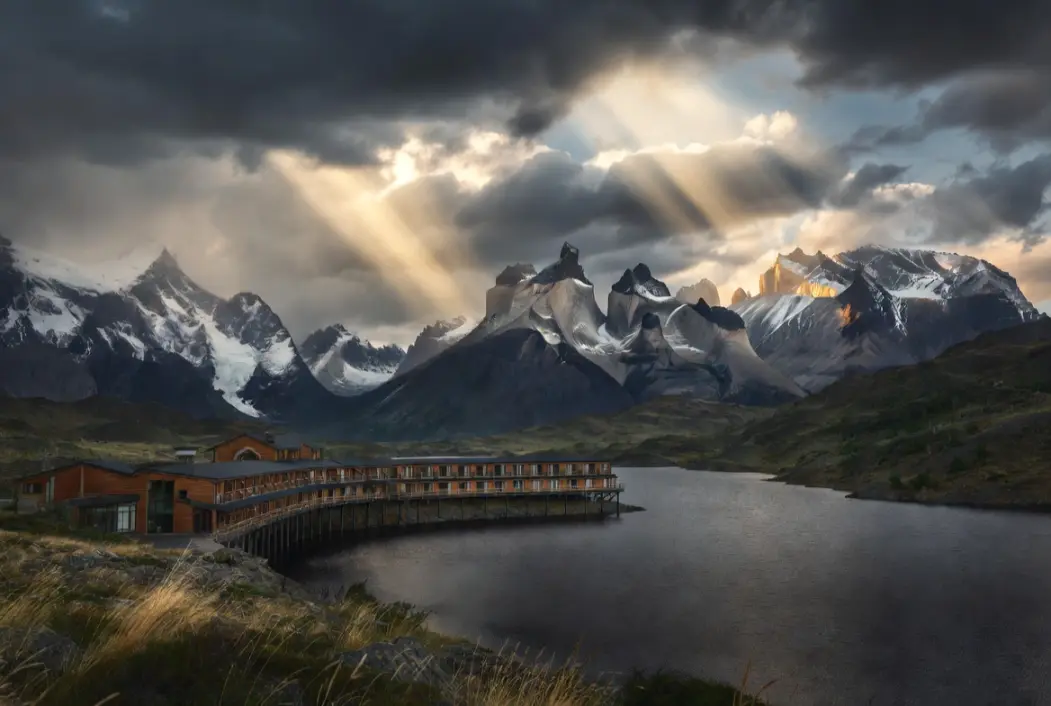
Where Architecture Bows to the Southern Sky
Set at the edge of Torres del Paine National Park in Chilean Patagonia, Tierra Patagonia is an architectural achievement as much as a hotel. The building curves low along the shore of Lake Sarmiento like a wave of weathered wood and glass, blending almost seamlessly into the steppe. From inside, the floor-to-ceiling windows frame views of the Paine massif, the sky, and the lake with the precision of a gallery.
Activities including horseback riding through the foothills, trekking on the famous W and O circuits, kayaking among glaciers, and early morning wildlife photography provide a framework for experiencing the park at genuine depth. Pumas, guanacos, rheas, condors, and flamingos are regularly spotted on excursions.
In a region where weather changes faster than anywhere else on earth, where a clear morning can become a horizontal snowstorm by afternoon, there is a deep satisfaction in returning to a warm and beautiful building that was created to withstand exactly this, and to let you appreciate it from the inside.
10. Treehouse Lodge, Amazon Rainforest, Peru
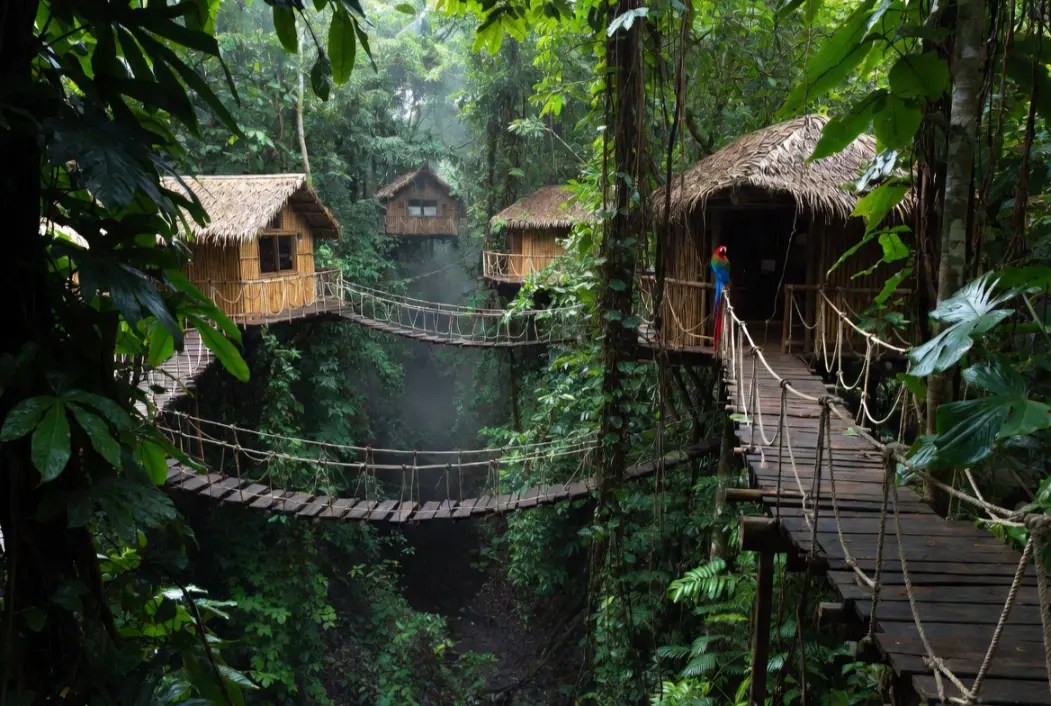
Life in the Canopy, Far Above the Forest Floor
Located within the Pacaya Samiria National Reserve in the Peruvian Amazon, the Treehouse Lodge suspends twelve individual treehouses between 35 and 75 feet above the jungle floor, connected by a network of rope bridges and wooden walkways. Each house has a proper bed, an en suite bathroom, mosquito netting, and the constant sound of the Amazon at every possible volume.
The perspective from these rooms is genuinely transformative. At ground level, a tropical rainforest presents as a wall of green. From a height of sixty feet, you begin to understand it as a layered world: the dark forest floor below, the mid-canopy rich with birds and insects, and the upper canopy spread out above you like a second sky. Sloths, pink river dolphins, caimans, and hundreds of species of Amazonian birds are regularly observed from the platforms.
The lodge runs on solar energy and is managed with a strict commitment to environmental preservation. For travelers who believe that the natural world is the most extraordinary hotel ever designed, the Treehouse Lodge offers something rare: a room inside it.
Conclusion
Travel, at its finest, is an act of radical openness: a willingness to place yourself somewhere unfamiliar and let that somewhere change you. The world’s most unique hotels understand this. They are not merely unusual places to sleep. They are environments designed to shift your perspective, expand your sense of what is possible, and leave you with memories that do not fade into the comfortable blur of routine.
Whether it is watching the Northern Lights from a glass igloo in Finland, sharing breakfast with a wild giraffe in Kenya, sleeping on a cliff face in the Peruvian Andes, or lying underwater on the Indian Ocean floor while octopuses drift past your window, these experiences offer something that no photograph can fully prepare you for.
The world is more creative than any architect and more generous than any hotel chain. The best properties on this list know this. They have built their reputations not by competing with nature, but by making it possible for their guests to sit still inside it, and listen.
Frequently Asked Questions
1. What makes a hotel truly unique compared to a standard luxury hotel?
A unique hotel is defined by its irreplaceability. It is inseparable from its specific environment, history, or architectural concept. The defining quality is not extravagance but specificity: the sense that this experience is available only here, in this form, and nowhere else in the world could replicate it.
2. Are unique hotels suitable for families with children?
Many are excellent for families, though suitability varies. Giraffe Manor and Kakslauttanen Arctic Resort actively welcome children. The Sky Lodge in Peru, which requires a multi-hour via ferrata climb, is not suitable for young children. Research each property’s age restrictions and physical requirements before booking.
3. How far in advance should you book unique hotels?
Most require bookings six months to a full year in advance. Giraffe Manor’s twelve rooms and the Manta Resort’s single underwater room are frequently reserved more than a year ahead. The Icehotel’s art suites often sell out within hours of their annual release. Book as early as possible.
4. Are unique hotels worth the premium price?
If you measure value by physical amenities per dollar, some will disappoint. But the more meaningful question is whether the memory, the perspective, and the story you carry forward for decades are worth the premium. For travelers who prize experience over comfort, the answer is almost always yes.
5. Are unique hotels generally more environmentally responsible?
Many are, because their business model depends on preserving the very environment that makes them special. The Treehouse Lodge runs on solar energy, Tierra Patagonia was built with a minimal-footprint philosophy, and Giraffe Manor supports giraffe conservation directly. However, not all unique hotels are automatically sustainable, so it is worth researching each property’s specific commitments individually.
You may also like this post: 9+ Best Resort Hotels in the USA in 2026